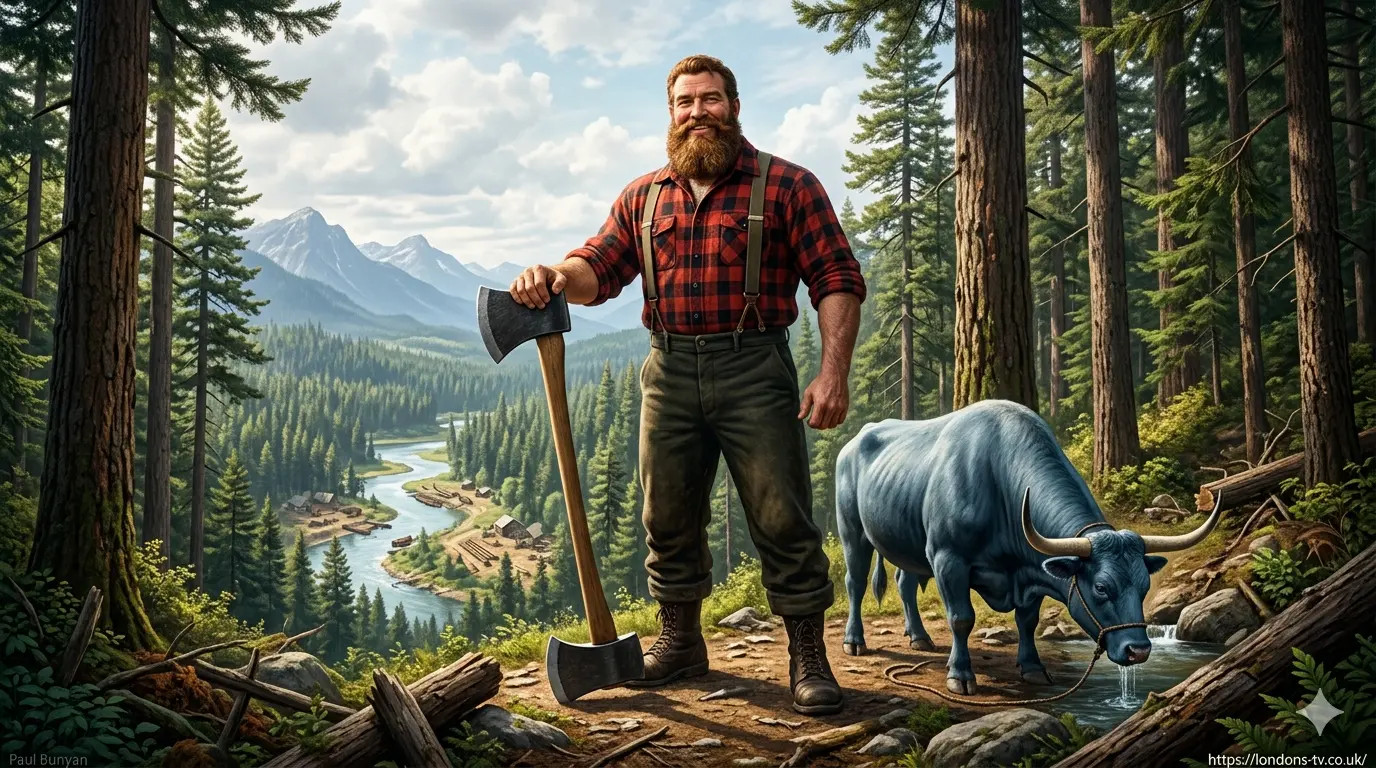
Among the many legends woven into the fabric of American culture, few stand taller—literally and figuratively—than Paul Bunyan. The colossal lumberjack, accompanied by his faithful companion Babe the Blue Ox, embodies the spirit of strength, determination, and humor that characterizes much of North American folklore.
For over a century, Paul Bunyan stories have captured the imagination of children and adults alike, blending myth and history into a narrative that celebrates the early logging industry, pioneer life, and the human capacity for hard work and creativity.
This article explores the origins, evolution, and enduring appeal of Paul Bunyan, the legendary woodsman who helped shape America’s storytelling tradition.
Origins of the Legend
The origins of Paul Bunyan are complex and somewhat mysterious. While the tales are widely known as American, many scholars trace their roots to the traditions of French-Canadian lumberjacks in the 19th century.
The name “Bunyan” may derive from the Québécois surname Bonyenne, an old French expression of surprise. The earliest versions of the legend likely emerged in the logging camps of the Great Lakes region, where lumberjacks told exaggerated stories to entertain each other after long days of backbreaking labor.
These oral traditions gradually evolved into tall tales, a storytelling style that thrived on hyperbole. The stories grew larger with each retelling, transforming ordinary loggers into titans who could shape mountains, carve rivers, and fell entire forests with a single swing of an axe.
The first printed reference to Paul Bunyan appeared in 1904, in a newspaper called the Duluth News Tribune. The character gained national fame in 1916 when William B. Laughead, an advertising writer for a logging company, used Paul Bunyan in a promotional pamphlet. Laughead expanded the myth and gave Bunyan many of the attributes we now associate with him, including his gigantic size and his partnership with Babe the Blue Ox.
The Character of Paul Bunyan
Paul Bunyan is portrayed as a towering lumberjack of almost unimaginable proportions. In some stories, he is said to be so tall that his footsteps create lakes, and so strong that he can clear entire forests in minutes. His strength is matched only by his kindness and ingenuity.
He is often depicted as a good-natured giant with a booming laugh and an unshakable sense of optimism. Paul embodies the frontier spirit—hardworking, self-reliant, and always ready to solve problems with creativity and grit.
The stories about Paul Bunyan are filled with exaggerations that border on the absurd, yet they carry a tone of admiration for the kind of person who doesn’t back down from challenges. Whether he’s carving out the Grand Canyon or creating the Great Lakes as watering holes for Babe, the tales celebrate human imagination as much as physical strength.
Babe the Blue Ox: More Than a Sidekick
No story of Paul Bunyan is complete without Babe the Blue Ox, his equally gigantic and loyal companion. According to legend, Paul found Babe during a blizzard when the ox was still a calf. The snow was so deep that Babe turned blue from the cold, and Paul decided to keep him as his faithful friend.
Babe quickly grew to match Paul’s enormous size, and together they became an unstoppable duo. Babe helped Paul haul massive logs, clear forests, and even reshape the American landscape.
In one story, the pair dragged their axes across the ground, forming the Mississippi River. In another, they created Minnesota’s 10,000 lakes by leaving footprints that filled with rainwater.
Beyond the humor, Babe represents more than just comic relief. The ox symbolizes partnership, loyalty, and the connection between humans and nature. Together, Paul and Babe illustrate that even the mightiest figures thrive when they work in harmony with others.
The Role of Paul Bunyan in American Folklore
Paul Bunyan stands at the intersection of myth and reality. His stories arose from the logging industry, a central part of America’s growth during the 1800s and early 1900s. Lumberjacks faced grueling conditions—cold winters, long hours, and dangerous work.
In that environment, tall tales served an important purpose. They offered humor and relief, helping workers bond and cope with hardship. Exaggeration became a form of entertainment and self-expression.
Through these stories, lumberjacks transformed their struggles into legendary feats. Paul Bunyan personified the strength, endurance, and perseverance required to survive in the wilderness. He became the ultimate logger—stronger than any man, yet humble and cheerful in his labors.
Over time, his legend evolved beyond the logging camps. Paul Bunyan became a symbol of American ingenuity and expansion, a mythical figure who mirrored the nation’s rapid growth and its drive to conquer the frontier.
Symbolism and Themes
The Paul Bunyan legend carries multiple layers of meaning. On the surface, the stories are humorous exaggerations filled with outlandish feats. But at their core, they represent deeper themes that resonate with American identity.
1. The Power of Human Imagination
The tales show how imagination can transform reality. Even though Paul’s feats are impossible, they reflect the human desire to explore, create, and overcome limits.
2. Respect for Nature
While Paul Bunyan is a logger who cuts down trees, the stories often highlight the beauty and vastness of the natural world. The landscapes he shapes are both grand and awe-inspiring, emphasizing humanity’s relationship with nature rather than its dominance over it.
3. Community and Cooperation
Paul never works alone. His friendship with Babe and his interactions with other lumberjacks highlight the importance of teamwork and mutual respect. The legend celebrates community as much as individual strength.
4. Humor as Resilience
The tall tales’ humor reflects a cultural truth: laughter helps people endure hardship. The workers who created these stories found joy in exaggeration, turning their daily struggles into epic adventures.
Regional Variations and Popular Tales
Paul Bunyan stories vary across regions, but several famous tales appear consistently throughout North America.
-
Creation of the Great Lakes: Paul dug the lakes so that Babe would have enough water to drink.
-
The Birth of the Grand Canyon: Some say Paul dragged his axe behind him while walking across the land, carving the massive canyon in his wake.
-
Minnesota’s Lakes and Hills: His giant footprints filled with water to form lakes, and his piles of wood chips became the region’s rolling hills.
-
Winter Logging Camps: Paul built enormous bunkhouses that could hold entire logging crews, complete with a stove so large it required entire trees for firewood.
Each story reflects the geography and humor of the region where it was told, giving the legend a distinctly local flavor while maintaining its universal appeal.
Paul Bunyan in Literature and Media
As American culture evolved, so did Paul Bunyan. His stories, once passed down orally, found new life in books, magazines, comics, and films.
In 1925, James Stevens published Paul Bunyan, one of the earliest literary collections of the tales, giving them a polished and humorous tone while preserving their folklore roots. Later, children’s books made the stories more accessible to young readers, presenting Bunyan as a friendly giant rather than a rough lumberjack.
Walt Disney’s 1958 animated short Paul Bunyan introduced the character to new audiences and cemented his image in popular culture. The film portrayed Bunyan as a symbol of progress and the American frontier spirit.
Today, Paul Bunyan continues to appear in various forms of media, from cartoons and advertisements to local festivals and roadside statues. Towns across the northern United States—especially in Minnesota, Wisconsin, and Michigan—celebrate him as a regional icon.
The Real History Behind the Myth
Although Paul Bunyan himself is a fictional creation, the stories reflect real aspects of American history. Logging was one of the first major industries in North America, essential for building homes, ships, and railroads.
The men who worked in logging camps were often immigrants from Canada and Europe, bringing with them rich storytelling traditions. Around campfires and bunkhouses, they exaggerated their experiences into tales of impossible size and strength.
In this sense, Paul Bunyan is a collective character—a product of many storytellers, each adding a new layer to his myth. He represents not a single person but the combined endurance, humor, and spirit of thousands of workers who helped build the nation.
Modern Interpretations and Legacy
In the modern world, Paul Bunyan’s story continues to evolve. Some view him as a symbol of human ambition, while others interpret his legend as a reflection on industrialization and environmental change.
Critics have pointed out that while Bunyan’s feats celebrate progress, they also mirror the environmental consequences of deforestation and expansion. Contemporary storytellers often use his myth to explore the balance between human achievement and ecological responsibility.
Despite these reinterpretations, Paul Bunyan remains a beloved figure. His image graces statues, murals, and festivals across North America. In Bemidji, Minnesota, a 31-foot statue of Paul Bunyan and a 10-foot Babe the Blue Ox welcome visitors from around the world. Similar monuments can be found in Maine, Michigan, Oregon, and other states, keeping the legend alive.
Cultural Impact and Enduring Appeal
Why does Paul Bunyan continue to capture our imagination after more than a century? The answer lies in his universality.
He is larger than life, yet deeply human. His stories speak to a shared longing for adventure, strength, and humor in the face of hardship. Paul embodies the idea that no challenge is too great and that through creativity and perseverance, anything is possible.
In an age of technology and rapid change, the legend of Paul Bunyan reminds us of simpler times—when storytelling connected communities, and imagination turned the ordinary into the extraordinary.
The tall tales endure because they tap into a timeless truth: that stories have the power to shape identity, preserve culture, and inspire future generations.
Conclusion
Paul Bunyan is more than a folklore hero. He is a reflection of the American imagination at its most expansive—a myth born from the sweat, laughter, and dreams of those who worked in the wilderness.
Through his strength and humor, Paul teaches lessons about resilience, creativity, and cooperation. He stands as a reminder that even in the most difficult conditions, people can create beauty, laughter, and lasting stories.
From the snowy forests of Minnesota to the mountain ranges of Oregon, Paul Bunyan’s spirit continues to echo through the pines. His legend remains a celebration of human endurance and the boundless possibilities of imagination.
So, the next time you see a massive tree stump or a deep valley carved into the earth, remember the mighty logger and his blue ox. Somewhere, in the heart of the American wilderness, Paul Bunyan is still swinging his axe, shaping the land—and the stories—that define a nation.